| CASE STUDY CoTrainerEnterprise When 92% Completion Means Nothing: Diagnosing a Failed ERP Go-Live Before the Wrong Budget Is Spent Blue Edgewater Consulting · Workforce Capability Intelligence |
| Organization Northgate Distribution Co. (fictional pilot) System Microsoft Dynamics 365 WMS Scenario Post go-live performance diagnosis | Tool CoTrainerEnterprise v1.0 Pipeline run 2026-06-19 · <10 minutes end-to-end Final status All 4 stages passed |
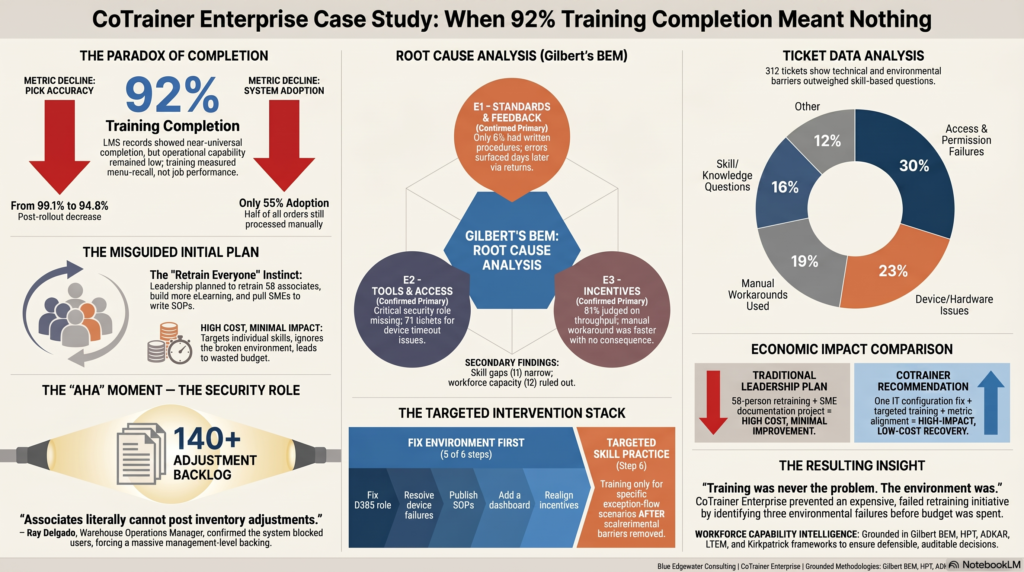
| The one-line verdict Training completed at 92%. Performance fell anyway — because the gap was never a training problem. Three environmental failures drove the collapse: associates couldn’t access the system they were asked to use, no written standard existed for the work they were asked to do, and their performance metrics rewarded the workaround. CoTrainerEnterprise identified all three before a dollar was spent on retraining. |
1. Background and Situation
Northgate Distribution Co. is a regional third-party logistics operator running a two-shift warehouse with 58 associates and 4 shift leads. Ten weeks before this assessment, the organization replaced a legacy green-screen WMS, paper pick tickets, and Excel-based inventory adjustments with Microsoft Dynamics 365 Supply Chain Management — Warehouse Management module, deployed on handheld mobile devices. The go-live was a single cutover with no parallel running period.
Pre-go-live training consisted of a 90-minute vendor webinar, a 22-minute mobile-device walkthrough video, and a readiness acknowledgement email. No sandbox time, no role-specific paths, no exception-handling content.
At week 10, the Director of Operations flagged the situation as urgent. The LMS showed near-universal completion; the warehouse floor told a different story.
Performance at Week 10
| 94.8% Pick accuracy ↓ from 99.1% pre go-live | −18% Throughput per hour vs. legacy baseline | 140+ Open adjustments backlogged, growing | 55% D365 adoption half of orders on paper | 1.9% Mis-ship rate ↑ from 0.6% | 92% Training completion looks fine — it isn’t |
The 92% completion figure is the starting paradox. High completion with deteriorating operational metrics is a signal that the training measured the wrong thing. The knowledge check assessed menu-location recall — whether associates could identify where a button was on a screen — not whether they could perform the work. Completion metrics and capability are not the same measure.
Leadership’s stated plan: retrain all 58 associates on D365. CoTrainerEnterprise ran the diagnosis first.
2. The Diagnosis — Gilbert’s Behavior Engineering Model
CoTrainerEnterprise applies Gilbert’s Behavior Engineering Model as its primary diagnostic framework. The BEM checks six possible causes of a performance gap in a deliberate order: environmental causes first (information, tools/access, incentives), individual causes second (skill, capacity, motivation). Environmental causes are checked first because they have higher leverage and lower cost to address than individual causes — and because training cannot fix them. A gap driven by environmental failure will not close with training.
The full six-cell diagnosis for this scenario:
| Individual Causes (checked after environment is cleared) | ||
| I1 POSSIBLE · Secondary Skill & Knowledge A narrow gap exists on 4 exception flows never covered in training: short-pick, LP split, cycle-count variance, adjustment posting. Standard orders are at 58% confidence and improving. | I2 RULED OUT Capacity Same workforce ran the legacy system at 99.1% accuracy. No physical, cognitive, or capacity evidence. The performance drop is post-cutover, not a workforce change. | I3 POSSIBLE · Modifier Motivation Third major change in 18 months. ADKAR barrier point: Desire. But disengagement is downstream of E3 — fix incentives and motivation follows. Not an independent cause. |
| What the ticket data reveals Of 312 help-desk tickets logged over 10 weeks: 30% were access/permissions failures, 23% were device hardware failures, 19% were associates explicitly declaring they’d used the manual workaround instead. Only 16% — 49 tickets — were genuine “I don’t know how” skill questions. The ticket mix alone tells the story: this is an environment problem, not a training problem. |
The Adjustment Backlog — One Configuration Error
The 140+ open inventory adjustment items dominating the backlog trace almost entirely to a single cause: the inventory-adjustment security role was never provisioned to the associate persona in D365. Associates are not avoiding the system — they are being blocked by it. Every adjustment routes to Ray Delgado, the Warehouse Operations Manager, who has the role and is personally posting 40–50 items per day, consuming 2–3 hours of management time daily.
Ray’s own assessment, in his written feedback at week 10:
| From the SME (Ray Delgado, Warehouse Operations Manager) “Adjustments are a mess and it’s not a skill issue — it’s an access issue. Associates literally cannot post inventory adjustments; the security role was never granted to them. So every single adjustment funnels to me. I’m doing 40–50 a day. That’s the backlog everyone’s worried about, and it would mostly evaporate if someone in IT just gave the floor the right permission.” |
The Incentive Problem — Rational Math, Not Resistance
Survey data shows 81% of associates agree their performance is judged on units shipped and on-time dock alone. No metric captures D365 compliance. The manual workaround is faster per transaction today, carries no consequence, and is explicitly tolerated by management during busy periods. From the survey free text:
| From the pulse survey (associate comments, anonymized) “I get measured on units shipped. The system way takes three extra taps per line, so on a busy day I just print the old pick sheet.” “Honestly there’s zero reason to fight with D365 when the manual way still works and gets me my numbers.” “Ray knows we work around it. As long as the trucks leave on time nobody says anything.” |
This is not a character or attitude problem. It is a straightforward incentive calculation. The BEM framework calls it E3 — incentives misaligned — and the data confirms it at high confidence. Training cannot change an incentive structure.
3. Training Verdict
| Pipeline verdict (R5 — required disclosure) Training is not the primary answer. The dominant causes of the performance gap are environmental: broken system access (E2), absent documented standards (E1), and a workaround that remains the rational choice under current measurement (E3). Targeted exception-handling practice is warranted for a specific set of tasks — but only after the environment is repaired. Full retraining of 58 associates would consume significant floor time and budget while changing nothing structural. |
Why the 92% Completion Rate Is Misleading
The five-question knowledge check administered before go-live assessed whether associates could identify menu locations and button names. It did not test whether they could perform a short-pick, resolve a cycle-count variance, or post an inventory adjustment. Recall of screen layout is not capability. The LMS confirmed that people watched the training. It said nothing about whether they could do the work.
Post-go-live confidence data tells a clearer story:
| Task | Confident | Root cause |
| Standard pick / pack / ship | 58% (improving) | E1/E3 primarily — skill building through exposure |
| Handling a short-pick | 11% | I1 — never trained, never practiced |
| Splitting / merging a license plate | 6% | I1 — never trained, never practiced |
| Resolving a cycle-count variance | 9% | I1 — never trained, never practiced |
| Posting an inventory adjustment | 4% | E2 primary — system blocks access entirely |
The confidence cliff between standard orders (58%) and exception flows (4–11%) is not evidence of broad workforce incapacity. It is evidence that four specific tasks were never covered in training and that, in one case, the system physically prevents completion. The correct response is targeted, not broad.
4. Recommended Interventions
The intervention plan follows directly from the diagnosis. Environmental causes are addressed before instructional causes — because training applied before the environment is repaired will produce the same outcome as the pre-go-live training: strong completion metrics, unchanged on-floor behavior.
| Intervention | Addresses | Type | Impact | Effort | Performed by |
| Fix inventory-adjustment security role in D365 | E2 — Access | Non-instructional | High | Low | IT/SysAdmin |
| Resolve handheld device timeouts and sync failures | E2 — Access | Non-instructional | High | Med | IT Infrastructure |
| Author site-specific SOPs and laminated job aids | E1 — Standards | Non-instructional | High | Med | Trainer (drafts); Ray reviews |
| Deploy compliance feedback dashboard on floor monitor | E1 — Feedback | Non-instructional | High | Med | BI Analyst |
| Realign performance metrics, communicate workaround end date | E3 — Incentives | Non-instructional | High | Med | Director + Manager |
| Targeted exception-flow practice: 4 scenarios, sandbox | I1 — Skill | Instructional | High | Med | Trainer/ID |
| Structured knowledge transfer: document Ray’s expertise | E2 — Key person | Non-instructional | High | Med | Trainer (captures); Ray reviews |
Sequencing
The implementation sequence matters as much as the interventions themselves. Environmental repairs must precede instructional interventions — associates cannot practice adjustment posting without the security role fix in place, and training will not transfer into an environment where the workaround is still faster and consequence-free.
Days 1–30: Fix the environment
- IT provisions correct D365 security role to associate persona (Days 1–3). Single configuration change. Collapses ~65% of the open ticket backlog.
- IT investigates and resolves handheld timeout and sync failures (Days 1–5).
- Trainer conducts structured capture sessions with Ray and authors site SOPs and laminated quick-reference cards. Ray reviews for accuracy — he does not write them (Days 5–20).
- BI analyst builds and deploys compliance dashboard on warehouse floor monitor (Days 15–30).
- Director delivers all-hands communication: D365 is permanent, workaround end date is named, compliance added to performance scorecard. This communication goes out after the access fix and job aids are confirmed in place — not before (Days 14–21).
Days 30–75: Targeted skills, key-person relief
- Trainer delivers exception-flow practice in small cohorts (8–10 associates): short-pick, LP split, cycle-count variance, adjustment posting. Sandbox-based, scenario-driven, task-completion assessment. Not a retake of the vendor webinar.
- Trainer conducts structured 90-minute knowledge-capture session with Ray; documents exception decision logic. Operations leadership designates a secondary to take over Tier-1 exception handling.
Days 90–120: Sustain and measure
- Level-3 structured observation: operations coordinator audits 20 randomly sampled exception-flow events per shift against SOP standard.
- Level-4 metric review against baselines (see Section 5).
- Quarterly SOP review cycle established. Designer revises, Ray approves.
What Is Not Recommended
The pipeline validated the following items as explicit “not recommended” — interventions that would consume budget without addressing the root causes:
- Not recommended: Full retraining of all 58 associates on standard D365 flows.
Associate confidence on standard tasks is already 58% and rising. The dominant causes are environmental. Broad retraining before the environment is repaired will replicate the go-live outcome: completion metrics up, on-floor behavior unchanged.
- Not recommended: Having Ray Delgado author all SOPs and documentation.
Ray is the highest-cost person on the floor and is already a bottleneck absorbing 2–3 hours of daily data entry. Assigning him documentation work while the adjustment queue persists deepens the key-person dependency. The correct pattern: trainer authors from a structured session, Ray reviews and corrects. Ray’s judgment is used only where genuinely required.
- Not recommended: Demo-only or passive e-learning for exception flows.
The go-live training was a demo-only screen tour and produced no exception-handling capability. Repeating that modality for the same task cluster will yield the same outcome. Only sandbox practice to execution standard is credible for procedural exception tasks.
The Intervention Economics Flag (R7)
CoTrainerEnterprise includes a validation rule — R7 — that fires when a recommendation assigns a high-cost executor to work a lower-cost role could perform. In this scenario, multiple evidence sources pushed toward “have Ray write all the procedures.” The pipeline flagged this.
| R7 flag — recorded in the audit log Recommendation: “Reset Incentive Structure” assigns performed_by = “Warehouse Operations Manager (Ray Delgado)” with performer_cost = “high.” The scorecard mechanics can be drafted by an Operations Analyst or coordinator for Ray’s review. Ray’s involvement is irreplaceable for the judgment call — not for the authoring labor. |
This flag does not block the pipeline. It is recorded in the audit log and surfaced as a non-blocking warning, so the decision-maker can assess it. In this case the flag is correct: Ray must own the leadership commitment, but an analyst can draft the scorecard mechanics. The distinction matters for both cost and for keeping Ray’s capacity available for higher-value work.
5. Evaluation Plan
Every CoTrainerEnterprise run produces a Kirkpatrick evaluation plan grounded in the specific diagnosis data. The targets below derive from the actual metrics identified in the intake and diagnosis stages.
Level 3 — Behavior / Transfer (Day 45 and Day 90)
The primary measure is whether associates are actually doing the work in D365 — not what they say about it. Observation method: system transaction audit plus structured shift-lead observation checklist (5 minutes per shift).
- Inventory adjustment posting rate in D365: target Ray’s daily manual queue below 5 per day by Day 60 (from 40–50).
- Paper/Excel workaround frequency on floor scorecard: target below 10% of order volume by Day 60, trending to zero.
- Exception-task escalation rate: are short-pick, LP split, and cycle-count variance tasks resolved by associates in D365 without supervisor intervention?
Level 4 — Business Results (Day 90 and Day 120)
| Metric | Baseline (week 10) | Target (day 90) | Stretch (day 120) |
| Pick accuracy | 94.8% | ≥98.5% | ≥99.1% (pre go-live) |
| D365 adoption (% orders in-system) | ~55% | ≥85% | 100% |
| Inventory adjustment backlog | 140+ open items | <15 items | <10 items |
| Mis-ship / returns rate | 1.9% | <0.9% | ≤0.6% (pre go-live) |
| Throughput per associate-hour | −18% vs. baseline | Within 8% of baseline | Full recovery |
| Ray’s daily adjustment queue | 40–50 items | <5 items | Near zero |
Ray’s daily adjustment queue is the single fastest-moving early indicator. If the security role fix lands by Day 3–5, the queue should fall materially within two weeks. A queue that does not drop confirms either the configuration change did not propagate correctly or there is a secondary access issue not yet identified.
6. Audit Trail and Methodology Traceability
Every CoTrainerEnterprise run produces a tamper-evident JSON audit record. It logs the pipeline version, the LLM provider and model, every methodology file used (with version), every validation rule result, every flag raised, and the final status. This record is not a summary — it is the machine-readable proof that the outputs are grounded in the methodology.
What the Audit Record Contains
- Run ID and timestamp: unique per execution, filesystem-safe.
- Scenario identifier and evidence source manifest: which files were loaded, in what order.
- Provider and model: cloud, Azure boundary, or offline — recorded exactly.
- Methodology pack name and version: which framework files drove the diagnosis.
- Per-stage entries: agent version, knowledge files referenced with versions, validation result (passed/failed/flags), retry count, duration.
- Final status: passed, partial, or failed. If failed, the blocking rule is named.
| From the actual run — 2026-06-19T0319Z-fee51a.json Stage: diagnosis | Passed: true | Retries: 0 Knowledge files: behavioral-engineering-model@1.0, training-warranted@1.0, change-fatigue@1.0, environmental-analysis@1.0, knowledge-transfer-risk@1.0, performance-gap-analysis@1.0, human-performance-technology@1.0 Stage: intervention | Passed: true | Retries: 0 Flags: R7 — “Reset Incentive Structure” assigns high-cost executor to scorecard authoring; lower-cost role can draft for review. Final status: PASSED |
Tuning Outputs Without Touching Code
When an output is wrong — a cost-of-performer calculation that doesn’t reflect an organization’s pay bands, a BEM threshold that doesn’t fit an industry context — the executor opens the relevant methodology file, finds the rule, edits it, and re-runs. No developer required. No ticket. No black box.
For example: the intervention-economics methodology file defines what constitutes a “high-cost executor” and what “low-value verbs” (write, draft, author, document) signal over-assignment of that executor. An enterprise can fork the Blue Edgewater methodology pack, adjust those definitions to their pay structure, and every future run reflects their approved version. The change is audited and versioned.
Provider Flexibility
The same pipeline ran in this case against the Anthropic API. The same configuration supports:
- Cloud (LLM_PROVIDER=anthropic): standard development and portfolio runs.
- Enterprise Azure boundary (LLM_PROVIDER=azure_openai): data residency requirements, internal endpoint, no external transmission.
- Offline / air-gapped (LLM_PROVIDER=local_offline): OpenAI-compatible local model server. No data leaves the machine. The methodology files and validation rules run identically regardless of the model underneath.
Provider is logged in every audit record.
7. Key-Person Risk
CoTrainerEnterprise surfaces key-person risk as a named diagnostic field, separate from the BEM analysis, because it represents an acute operational vulnerability that often goes unrecognized until someone leaves.
In this scenario, Ray Delgado is a bus factor of one across two dimensions simultaneously: he is the sole person authorized to post inventory adjustments (due to the security role gap), and he is the sole system expert whose procedural knowledge exists only in his head. These risks interact — leaning on Ray to author documentation while the adjustment queue consumes 2–3 hours of his day makes both worse, not better.
| Key-person risk summary Ray Delgado holds exclusive working knowledge of D365 exception handling and is the only person authorized to post inventory adjustments. There is no documented fallback, no trained secondary, and no night-shift equivalent. If Ray is unavailable, adjustment processing stops entirely. The current load is unsustainable — the risk of burnout or voluntary departure is real and would convert a manageable capability gap into a crisis. |
The intervention set addresses both dimensions through a single coordinated approach: fix the access (removes the adjustment queue from Ray), have a trainer capture and document the exception decision logic in a structured session (Ray reviews, not writes), and designate a secondary to take over Tier-1 exception handling once the documentation exists. Ray’s time is used only where his judgment is genuinely required.
This is the same key-person risk pattern CoTransfer is designed to surface proactively — before the go-live, before the queue, before the crisis. CoTrainerEnterprise surfaces it reactively, at week 10, when it is already manifesting as a 140-item backlog.
8. What This Means for Leadership
The instinct in this scenario — retrain everyone — is understandable. Completion metrics were strong, the system was new, and performance fell. The natural conclusion is that the training didn’t work and should be repeated more thoroughly.
CoTrainerEnterprise reframes that conclusion with evidence. Training didn’t fail because it was the wrong training. Training didn’t address the problem because the problem was never a training problem.
| What leadership was planning Full D365 retraining for all 58 associatesPull Ray off the floor to author all proceduresAdd more video content and knowledge checks Estimated cost: 58 associates × 1 day off floor + contractor training build + Ray’s time over 3–4 weeks. Projected outcome: completion metrics up again, floor behavior unchanged, backlog persists, Ray more overloaded. | What the pipeline recommended One IT configuration change to fix system access (Days 1–3)Trainer-authored SOPs from a 60-minute session with Ray reviewingLeadership communication + scorecard change (not a training event)Targeted 2–3 hour exception-flow practice after environment is repaired Projected outcome: adjustment backlog clears within two weeks, D365 adoption climbs once the workaround has a consequence, pick accuracy recovers to baseline by Day 90. |
| The most important number in this case study 92%. Ninety-two percent of associates completed the training and passed the knowledge check before go-live. The training looked successful by every standard metric. It produced no lasting on-the-job behavior change because it was built on a broken environment. Without the diagnosis, the next training program would have been built on the same broken environment — with equally strong completion metrics and the same outcome on the floor. |
9. Methodology and Framework Grounding
CoTrainerEnterprise’s diagnostic logic is grounded in established instructional systems design and human performance technology frameworks. The methodology files are portable markdown documents encoding decision rules derived from primary sources — not invented heuristics.
| Framework | Application in CoTrainerEnterprise | Primary source |
| Gilbert’s Behavior Engineering Model | Six-cell diagnostic framework. Environment-first ordering. Training warranted gate. | Gilbert, T.F. (1978). Human Competence. |
| Mager & Pipe Performance Analysis | “Mager & Pipe test” — distinguishes “can’t do” from “won’t do.” Validates whether training is an appropriate response. | Mager, R.F. & Pipe, P. (1997). Analyzing Performance Problems. |
| Van Tiem / Moseley HPT Model | Cause analysis and intervention selection logic. Non-instructional intervention taxonomy. | Van Tiem, D. et al. (2012). Fundamentals of Performance Improvement. |
| Prosci ADKAR | Change climate assessment. Barrier-point diagnosis. Desire vs. Knowledge distinction. | Hiatt, J. (2006). ADKAR: A Model for Change. |
| Kirkpatrick Model | Evaluation plan structure. L3 (behavior/transfer) and L4 (business results) targets. | Kirkpatrick, J. & Kirkpatrick, W. (2016). Four Levels of Training Evaluation. |
| LTEM (Thalheimer) | Assessment design standard. Tier 6 (task demonstration) vs. Tier 4 (recall) distinction. | Thalheimer, W. (2018). Performance-Focused Learner Surveys. |
| Molenda & Pershing | Intervention prioritization by impact, effort, and cost. Strategic Impact Model. | Molenda, M. & Pershing, J. (2004). Strategic Impact Model. |
All methodology files are stored as versioned plain-text documents in the CoTrainerEnterprise methodology pack. An enterprise can inspect, fork, and maintain their own version of the pack without touching application code. Every run logs which files and which versions produced which outputs.
10. About CoTrainerEnterprise and Blue Edgewater Consulting
CoTrainerEnterprise
CoTrainerEnterprise is an agentic performance diagnosis pipeline — part of the Workforce Capability Intelligence (WCI) platform built by Blue Edgewater Consulting. It takes workforce evidence through a four-stage pipeline: structured intake, BEM diagnosis, intervention planning, and audience-specific artifact generation. All outputs are validated by a deterministic rule engine (R1–R7) that runs independently of the language model. Every run produces a tamper-evident audit log.
The pipeline runs on three deployment modes: cloud (Anthropic API), enterprise Azure boundary, or offline against a local model. The methodology files — the rules that drive the diagnostic logic — are portable, swappable markdown documents that non-technical users can tune without code changes.
The WCI Platform
CoTrainerEnterprise is one of four tools in the Workforce Capability Intelligence platform:
- CoTransfer — Discovers hidden expertise before it walks out the door. Bus-factor analysis, knowledge inventory, structured capture sessions.
- CoBuild — Transforms captured SME expertise into learning assets through an agentic content pipeline.
- CoSignal — Monitors workforce capability risk over time, detecting drift in performance signals before they become crises.
- CoTrainerEnterprise — Diagnoses performance gaps and recommends the right interventions. Validates that training is the answer before anyone builds a course.
CoTrainer and the Stepping-Stone Model
CoTrainer is the practitioner-facing app that underpins CoTrainerEnterprise. An L&D professional or performance consultant answers five questions and receives instant consultant-grade outputs: leadership brief, intervention recommendations, training cadence design, and training builder artifacts. CoTrainer proves the methodology concept and builds organizational confidence in evidence-based diagnosis.
CoTrainerEnterprise adds the governance layer: deterministic validation, tamper-evident audit, swappable methodology, and enterprise deployment options. The app creates the relationship with the methodology; the pipeline scales it into an enterprise-grade, auditable system.
Blue Edgewater Consulting
Blue Edgewater Consulting is an independent instructional design and AI consulting practice founded by Jason Bourque, MS Learning Design and Technology (Purdue University). Blue Edgewater specializes in the intersection of enterprise L&D, AI systems design, and workforce performance analytics — helping organizations build, deploy, and govern AI-powered learning and performance tools that produce defensible, measurable outcomes.
Blue Edgewater Consulting · Workforce Capability Intelligence · blueedgewater.com
CoTrainerEnterprise is part of the WCI platform. Grounded in Purdue MS Learning Design & Technology methodology.