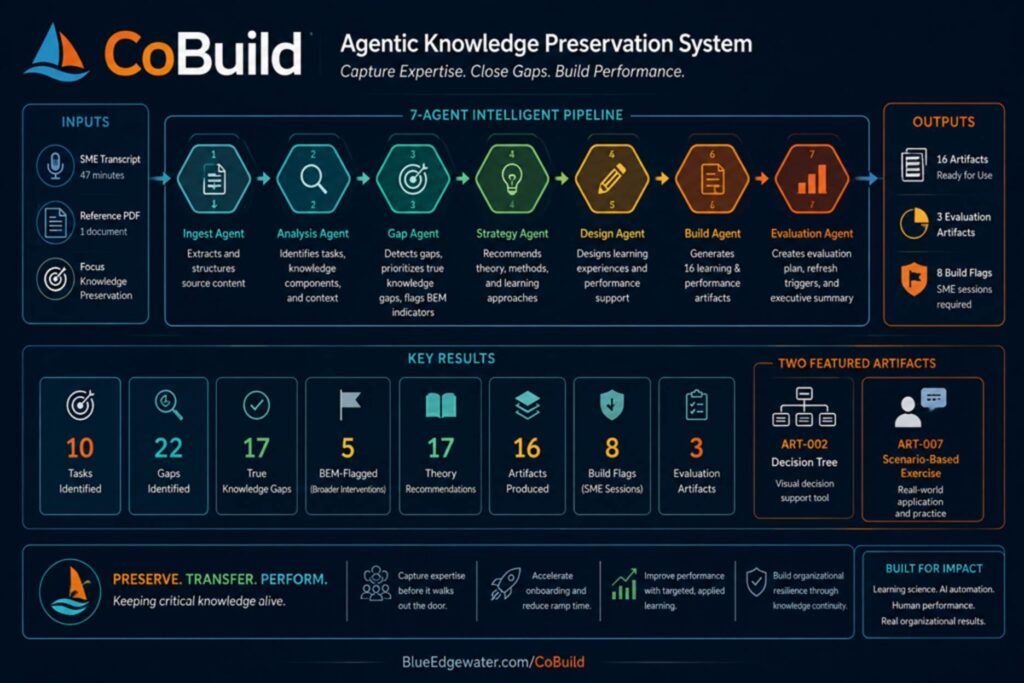
CoBuild was designed to solve a growing challenge facing organizations everywhere: critical knowledge disappears when experienced employees leave, retire, or transition roles. Built at the intersection of learning science, instructional design, and agentic AI workflows, CoBuild transforms tribal knowledge, legacy documentation, and subject matter expertise into structured performance support systems that help organizations preserve expertise, accelerate onboarding, and build resilient learning ecosystems. This case study demonstrates how AI-assisted knowledge preservation can move beyond information storage and become a scalable strategy for improving workforce capability and organizational continuity.
BLUE EDGEWATER CONSULTING
Case Study
CoBuild
An Agentic Knowledge Preservation System
| Preserve human expertise before it walks out the door. |
Jason Edgewater · Blue Edgewater Consulting · blueedgewater.com
Pilot completed: May 2026 · CoBuild v1.0
The Problem
Every organization has a single point of failure on its org chart.
The senior finance lead who owns the month-end close. The warehousing supervisor who knows which scanner needs to be reset on humid mornings. The grants manager who remembers why three federal reports use a non-standard fiscal calendar. The volunteer coordinator who has the cell phone numbers of every reliable Saturday morning crew.
When these people retire, go on leave, or take another job, organizations discover something uncomfortable: the SOPs they spent years writing don’t contain the knowledge they actually need. The procedures are documented. The reasoning, the workarounds, the relationships, the judgment calls — all of that lives in one person’s head.
This is the tacit knowledge problem. Most organizations confront it the same way: too late.
| CoBuild was built to confront it on purpose. |
What CoBuild Is
CoBuild is an agentic system that captures the expertise of a single high-knowledge employee and produces a layered set of performance support artifacts a team can use to continue operating without them. It is not a chatbot, a documentation generator, or an LMS.
It is an instructional design pipeline — built from real L&D team roles, grounded in established learning science, and orchestrated through AI agents.
| The system answers one question: If this person became unavailable tomorrow, what would the team need on Monday? |
The Pilot
To validate CoBuild end-to-end, I designed a pilot around a universally legible scenario: a senior finance lead at a mid-sized organization goes on extended medical leave with two weeks’ notice. She owns the period-end close process in Microsoft Dynamics 365 Finance & Operations — depreciation runs, inter-company eliminations, period status management, and the dozens of small judgment calls that make the difference between a clean close and a week of rework.
Why D365 Finance period-end close
- Complex enough to be a meaningful test — touches six modules, real configuration choices, coordination across finance, operations, and IT
- Generic enough to demonstrate publicly — every reference is to publicly documented D365 functionality, no client data
- Immediately recognizable across industries — every organization understands losing the person who closes the books
Pilot inputs
- 1 synthetic SME interview transcript (47 minutes, 6 deliberately planted tacit knowledge gaps)
- 1 D365 Finance reference document (publicly available textbook chapter, Luszczak 2023)
- 1 organizational knowledge base (Obsidian vault with framework references)
The Architecture
CoBuild runs seven agents — including Agent 3.5, a Learning Theory Selection Agent that sits between the Knowledge Gap Agent and the Instructional Strategy Agent. Each agent maps to a real position on a learning team, has one job, one input, and one handoff.
| # | Agent | L&D Role | Purpose |
| 1 | Intake | Needs Analyst (ingestion) | Cleans, chunks, and tags every source document |
| 2 | Task & Criticality | Needs Analyst | Inventories every task and scores by risk |
| 3 | Knowledge Gap | Needs Analyst + SME Liaison | Surfaces what the expert knows that isn’t written down |
| 3.5 | Learning Theory | Instructional Designer | Selects the right learning theory per gap |
| 4 | Instructional Strategy | Instructional Designer | Decides what artifact type each gap needs |
| 5 | Artifact Builder | Content Developer | Produces job aids, scenarios, decision trees |
| 6 | Evaluation | Evaluator / Analyst | Builds Kirkpatrick + LTEM measurement plan |
What makes Agent 3.5 different
Most AI-in-L&D tools assume every problem is a training problem and apply the same design approach to every gap. Agent 3.5 applies four learning theory lenses — Behaviorism, Cognitivism/CIP, Social Cognitive Theory, and Constructivism — to each true knowledge gap, then recommends the theory whose predictions best explain how transfer will succeed or fail for that specific gap.
Agent 4 receives these theory recommendations as binding inputs. If it overrides a recommendation, it must document why. This makes every artifact design decision traceable to a learning science rationale — not just a pattern match on gap type.
The Learning Science
CoBuild integrates five frameworks, applied at specific points in the pipeline:
- Gilbert’s Behavior Engineering Model (BEM) — Applied in the Knowledge Gap Agent to distinguish true knowledge gaps from environmental, incentive, or resource problems. Prevents CoBuild from generating training for problems training won’t solve.
- Four learning theories (Behaviorism, Cognitivism, SCT, Constructivism) — Used per gap by Agent 3.5 to select the theory whose predictions best match the transfer challenge.
- Gagné’s Nine Events of Instruction — Applied in the Instructional Strategy Agent as a completeness lens — ensuring artifacts include the scaffolding a performer actually needs.
- Bloom’s Taxonomy — Used to level learning objectives so the right cognitive demand is matched to the right task and artifact type.
- The Kirkpatrick Model — Used in the Evaluation Agent as the leadership reporting layer — what to measure, when, and what success looks like.
- Will Thalheimer’s LTEM — Used in the Evaluation Agent as the diagnostic layer underneath Kirkpatrick — if transfer fails, which tier of the chain broke, and what does that tell the designer about whether to fix the artifact or fix the environment.
The integration of these frameworks is what makes CoBuild’s output defensible as instructional design rather than generated content.
Pilot Results
The full pipeline was run against the synthetic Maria transcript in a single session. All seven agents passed validation.
| Metric | Target | Actual | Status |
| Planted gaps found | 6 of 6 | 6 of 6 | ✓ Pass |
| Tasks identified | ≥ 15 | 10 (scoped transcript) | ✓ Pass |
| Priority tasks | ≥ 6 | 8 | ✓ Pass |
| Gaps identified | — | 22 total | ✓ Pass |
| True knowledge gaps | — | 17 | ✓ Pass |
| BEM-flagged (non-training) | ≥ 1 | 5 | ✓ Pass |
| Theory recommendations | All 4 theories | 17 (4 theories) | ✓ Pass |
| Artifacts produced | — | 16 | ✓ Pass |
| Build flags | — | 8 (SME sessions) | ✓ Expected |
| Evaluation artifacts | 3 | 3 | ✓ Pass |
What the Knowledge Gap Agent found
Of the 22 gaps identified, 5 were BEM-flagged as environment problems rather than knowledge problems. The most significant: the operations coordination gap — which appeared to be a knowledge gap (‘how do I work with the warehousing contact?’) but was actually a relationship capital and system access problem that no training artifact could solve.
CoBuild explicitly routed these five items to non-instructional intervention recommendations rather than generating training artifacts for them. That distinction is the most important thing CoBuild does.
What Agent 3.5 found
Across 17 true knowledge gaps, Agent 3.5 identified four distinct theory assignments:
- 6 gaps — Behaviorism primary (high-frequency procedural tasks where automaticity is the goal)
- 5 gaps — Cognitivism primary (configuration rationale, navigation/lookup, schema extension)
- 3 gaps — Social Cognitive Theory primary (expert judgment, self-efficacy at risk, relationship gaps)
- 3 gaps — Constructivism primary (decision-making, exception-handling, high-stakes variable conditions)
Agent 3.5 also identified 4 transfer risks not caught by BEM analysis — including the accrual reversal configuration gap, where the risk was not that the successor couldn’t learn the setting, but that a confident D365 user might recognize it as non-default and ‘fix’ it, creating a cascade of errors.
What Agent 5 produced
16 performance support artifacts across five types:
- 6 Job Aids — step-by-step procedural references for high-frequency tasks
- 6 Decision Trees — branching guides for exception handling and escalation decisions
- 1 Scenario — consequence-based practice for the highest-stakes judgment call
- 2 Microlearning scripts — conceptual explanations for configuration rationale gaps
- 1 Reference Card — fast-lookup navigation for the fixed assets validation query
8 build flags were produced — each identifying a specific SME session required before the artifact can be deployed. Agent 5 refused to hallucinate missing content (account numbers, checklist items, navigation paths) and instead created clearly marked INSERT placeholders with explicit instructions for the content developer.
What Agent 6 produced
A Kirkpatrick + LTEM measurement plan covering all 16 artifacts, specifying:
- Minimum viable measurement path per artifact (L1 only vs. L1+L2+L3 depending on artifact type and risk score)
- LTEM diagnostic decision rules for each artifact — if Tier X passes but transfer fails, the gap is environmental; if Tier X fails, return to the artifact design
- Level 4 business outcome metrics with explicit baselines and success thresholds
- An executive summary written in plain language for the controller or VP of Finance — zero jargon
What CoBuild Does Not Do
Three important constraints:
- CoBuild does not replace the SME. CoBuild requires real input from a real expert. Its value is in making that input go further, not in fabricating expertise from nothing.
- CoBuild does not replace the instructional designer. The system produces artifacts that need human review, contextual judgment, and stakeholder validation before deployment. CoBuild acts as a force multiplier on a designer’s time, not a substitute for their craft.
- CoBuild does not solve adoption. The artifacts still need to be delivered, used, reinforced, and refreshed. The Evaluation Agent’s measurement plan is the starting point for that work, not the end of it.
Architecture Portability
CoBuild v1 was built on Claude Code with Anthropic’s API. The agent prompts, pipeline architecture, and output schemas are model-agnostic by design.
Organizations operating in locked-down environments — government, defense, regulated healthcare, large enterprise — can implement the same pipeline using:
- Azure OpenAI Service (GPT-4o or Azure-hosted Claude) with Azure AI Foundry orchestration
- Microsoft Semantic Kernel for agent coordination in Azure-native environments
- A self-hosted model (Llama, Mistral, or similar) running on Azure ML or on-premises infrastructure
- Azure AI Search with vector indexing on SharePoint/OneDrive for the knowledge base layer
The agent system prompts are plain text. The pipeline orchestration is standard Python. The output formats are markdown and JSON. None of these are platform-specific. CoBuild is designed to run inside the network boundary, not around it.
What’s Next
v2 — Second pilot, different domain
Candidates: volunteer onboarding for a nonprofit, sailing curriculum knowledge transfer, marina operations. Each demonstrates CoBuild generalizing beyond enterprise finance. Adds vector retrieval if Obsidian search proves insufficient at scale. Adds a simple intake UI for non-technical users.
v3 — Blue Edgewater service offering
Multi-tenant. Scheduled refresh cycles. LMS integration for artifact delivery. Available as a consulting engagement (CoBuild run for a specific knowledge-at-risk role) and as a productized capability for organizations facing recurring knowledge continuity challenges.
About the Designer
Jason Edgewater is an instructional designer and Training Developer with an MS in Learning Design and Technology from Purdue University. He has spent several years designing role-based training for large-scale enterprise system implementations, including Microsoft Dynamics 365, and is the founder of Blue Edgewater Consulting.
CoBuild grew out of a question he kept asking on every enterprise rollout:
| We are spending months training people on the new system. Why are we not spending equivalent effort capturing what the people leaving the old system actually know? |
Get in Touch
If your organization is facing a known knowledge continuity risk — a planned retirement, a key role transition, a consulting engagement ending, an ERP go-live where the legacy experts are about to walk out the door — Blue Edgewater offers CoBuild as a consulting engagement.
jason@blueedgewater.com
blueedgewater.com
CoBuild v1.0 · May 2026 · Blue Edgewater Consulting